Method 02 — Thinking with your hands and bricks
LEGO® SERIOUS PLAY®Don't present your strategy. Build it.
A question on the table. Bricks in every hand. Each person builds an answer, explains their model, and the group turns those models into a shared vision, a common plan and strategic choices.
Discuss your next workshopWhat people do.
The facilitator sets a challenge; everyone builds their own model in response; each person explains what they built; the group reflects. The work then moves to shared models, landscapes, connections and scenarios, and ends with priorities and principles for decision-making.
Why it works this way.
Developed from 1996 by Johan Roos and Bart Victor at IMD with Kjeld Kirk Kristiansen, then leading the LEGO Group, the method was designed as an alternative to conventional strategic planning: building 3D models of business issues to support adaptive strategy. It draws on constructionism — building a tangible, external model is a way of thinking — and on metaphor and storytelling. Since 2010 the method has been shared as an open-source community model.
Explore the foundationsWhat takes shape.
An agreed representation of the situation, strategic priorities and principles, and a next-step plan with responsibilities. The exact deliverables are designed with the sponsor.
Certified facilitators,
a practised craft.
Hélène Michel and Mathias Salanon have been certified LEGO® SERIOUS PLAY® facilitators since 2016, after the Master Training ofThe Association of Master Trainers in the LEGO® SERIOUS PLAY® Method — the full-level training in facilitating and designing with the method. They have run dozens of LEGO SERIOUS PLAY workshops in recent years.
Opopoï works exclusively with facilitators certified in the method.
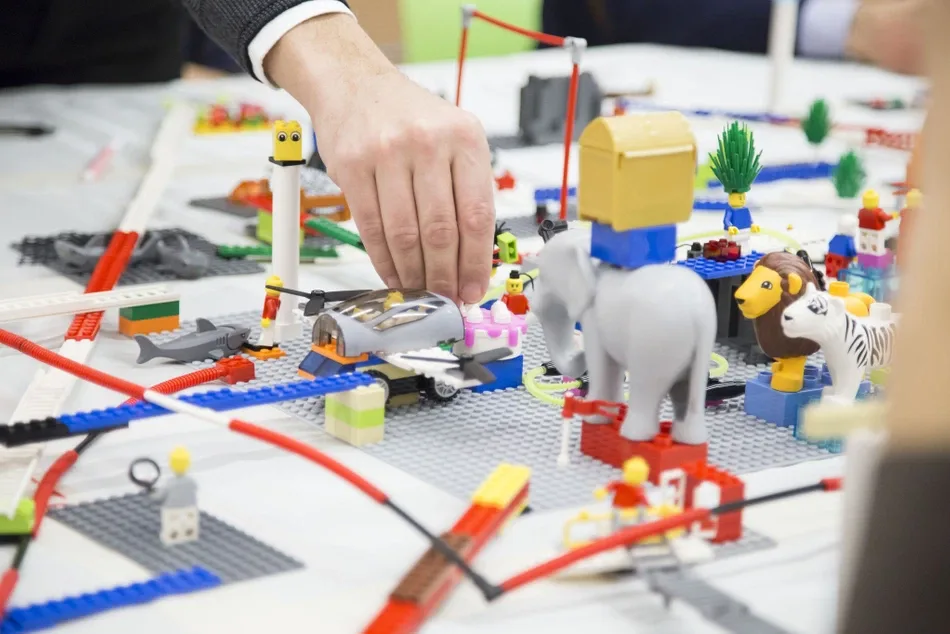
Build, explain, reflect
The core of the method is a simple cycle: a challenge is set, everyone builds their own answer with the bricks, each person explains their model, and the group reflects. Everyone builds; everyone is heard before any interpretation. The knowledge is already in the room; the cycle makes it available to the group.
From individual models to shared landscapes
Individual models then become shared models, and then landscapes: elements are positioned and connected, and dependencies are named. The group can play out scenarios on this landscape — a competitor moves, a constraint disappears — and draw simple guiding principles for its decisions.
What organisations use it for
Shared vision, team strategy, stakeholder relationships, customer perspectives, scenario exploration and priority alignment. The value is not only a better conversation: it is a shared material from which to decide.
What the session delivers
Depending on the intent agreed with the sponsor: an agreed representation of the situation, strategic priorities and principles, and a next-step plan with responsibilities. The exact deliverables are defined during scoping, around your question and the planned follow-through.
Where the method comes from
LEGO SERIOUS PLAY began in 1996 inside the LEGO Group, from the work of Johan Roos and Bart Victor (IMD) with Kjeld Kirk Kristiansen, as a different way of doing strategy. In 2010 the method moved to an open-source community model. Opopoï has practised it since 2015.
From the first exchange
to the next steps.
This sequence is illustrative. Content, working time and deliverables are designed around your context.
- 01
Learn the language
Short exercises to get comfortable building and explaining through metaphor.
- 02
Build individual answers
Everyone constructs a model in response to the challenge and explains it to the group.
- 03
Connect the landscape
Shared models, connections, dependencies and scenarios.
- 04
Decide what follows
Priorities, principles, next steps and responsibilities.
A format
built around you.
- Participants
- Executive committees, leadership teams, project teams and groups working through a strategic question.
- Group size
- Designed around the objective, speaking time and facilitation requirements.
- Duration
- Scoped around the challenge, with time to learn the approach.
- Languages
- French / English
Good
questions.
Do participants need LEGO skills?
No. The model's aesthetic quality is irrelevant. Introductory exercises establish a shared language.
Is it suitable for an executive committee?
It can support a leadership question when the brief, confidentiality and decision remit are clear. We choose the method after understanding your challenge.
Can the workshop take place at our office?
Yes, or at a suitable external venue. Space, tables and materials are agreed during preparation.
You bring
the question.
We give it form.
A question to clarify. A team to bring together. An idea to put to the test. Let’s start with a conversation.
Discuss your next workshop