Method 05 — Recruitment through games and gamified scenarios
Rethinking recruitmentA CV tells a story. A game reveals a way of playing.
Recruiters and applicants play games together around a table — cooperatively or competitively, to win. Around the game you can observe initiative, strategy, attitude, smart moves, cooperation and choices.
Discuss your next workshopWhat people do.
Applicants and recruiters join the same games and gamified scenarios, in teams or in competition. Recruiters observe behaviours defined beforehand with the HR team, then a conversation puts what was observed into context.
Why it works this way.
Playing together creates a common context for observation: neither a disguised interview nor assessment role-play, but a recruitment practice in its own right. Indicators are developed with HR professionals. One game remains a sample of behaviour, not a personality diagnosis.
Explore the foundationsWhat takes shape.
Structured observations — initiative, strategy, attitude, cooperation, choices — and further questions for the hiring process. These complement other evidence rather than automatically replacing it.
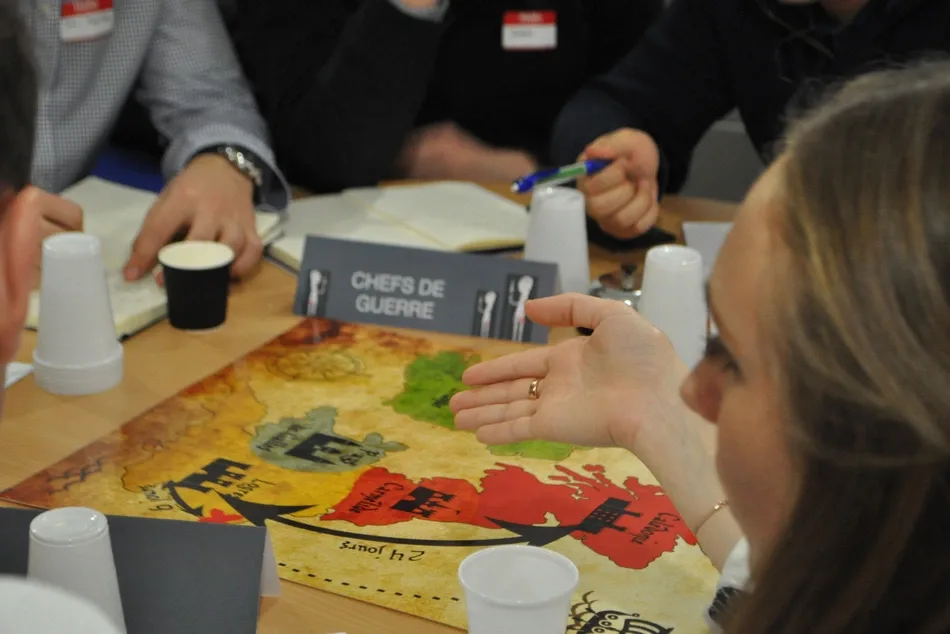
Play together, not assess from a distance
Recruiters and applicants are in the same game: cooperating towards a shared goal or competing to win. How people play — initiative, strategy, attitude, smart moves, cooperation, choices under pressure — is directly visible, to both sides.
Define before observing
What does initiative mean in this role? What observable behaviour demonstrates useful collaboration? The work starts with clear criteria developed with those responsible for hiring.
An encounter, not a trap
The rules and the goal of the game are clear to everyone. The environment is designed to help participants engage and genuinely meet. Accessibility and the use of observations are agreed during scoping.
Connect the game to the role
A game is useful only if the observations inform a professional question. The debrief distinguishes observed facts, interpretations and points requiring a further conversation.
From the first exchange
to the next steps.
This sequence is illustrative. Content, working time and deliverables are designed around your context.
- 01
Define criteria
Choose behaviours relevant to the role.
- 02
Explain the rules
Establish a clear, shared game context.
- 03
Play
Facilitate the games — cooperative or competitive — and record observations.
- 04
Discuss and contextualise
Compare observations with other recruitment evidence.
A format
built around you.
- Participants
- HR teams, recruiters and hiring managers.
- Group size
- Depends on roles, participant numbers and fair participation requirements.
- Duration
- Designed around the selected games and time needed for candidate conversations.
- Languages
- French / English
Good
questions.
Does this replace interviews?
It provides another source of evidence. Its relationship with interviews and other stages is designed with your HR team.
Are the games the same for every role?
No. Objectives, criteria and games are built around the recruitment need.
You bring
the question.
We give it form.
A question to clarify. A team to bring together. An idea to put to the test. Let’s start with a conversation.
Discuss your next workshop