Method 03 — Start with the customer
Value Proposition DesignCreate products and services your customers actually want.
A workshop to create products and services your customers actually want. Understand in depth what your customers are trying to get done, connect your offer to their priorities, then put your riskiest assumptions to the test before you invest.
Discuss your next workshopWhat people do.
The group profiles one priority customer — the functional, social and emotional jobs they are trying to get done, their pains and the gains they expect — without treating them all as equal. It then builds the offer's value map: products and services, pain relievers and gain creators. Set side by side, profile and map reveal fit, feed alternatives and frame tests of the most critical assumptions.
Why it works this way.
The method comes from Value Proposition Design by Alexander Osterwalder, Yves Pigneur, Gregory Bernarda and Alan Smith (Wiley, 2014), extending the Business Model Canvas. Its premise: an offer creates value only when what it brings matches what the customer is trying to get done — and that match can be designed, prototyped and tested. You compare several propositions, confront the riskiest assumptions with evidence and iterate before committing heavy investment.
Explore the foundationsWhat takes shape.
A detailed, prioritised customer profile, an explicit value proposition — or several prioritised options — visible connections between needs and offer, and a test plan to inform the next product or service decisions.
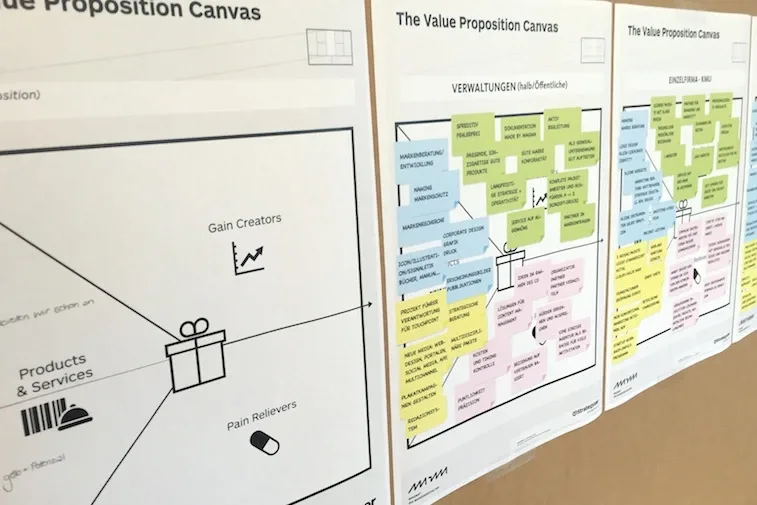
Understand the customer in depth
Not all expectations carry the same weight. The workshop distinguishes the functional, social and emotional jobs a customer is trying to get done, what gets in their way and what they hope to gain — then prioritises: some jobs matter more, some pains are more severe, some gains more decisive. That ranking is what steers the offer.
Connect the value map to the profile
Facing the profile, the group maps the offer's value: products and services, concrete pain relievers, gain creators. Every element of the offer is tied to an identified need — exposing the real connections, the gaps to close and the selling points that answer nothing.
Design and compare several propositions
A first value proposition is only a starting point. The workshop also sketches alternatives, prototypes them in a simple form and compares them against the customer profile, so the promise worth pursuing is chosen deliberately.
Test before you invest
Fit found on a canvas remains a hypothesis until it meets the field. The group identifies its most critical assumptions — the ones the decision depends on — and designs the tests that will produce learning fast: interviews, experiments, prototypes. This is the step that comes before major investment.
From the first exchange
to the next steps.
This sequence is illustrative. Content, working time and deliverables are designed around your context.
- 01
Choose the customer
Define a priority segment and a context of use.
- 02
Draw the profile
Describe and prioritise jobs, pains and desired gains.
- 03
Build the value map
Connect products, services and value creators to priority needs, then compare alternatives.
- 04
Prepare the tests
Prioritise critical assumptions and design the evidence to collect.
A format
built around you.
- Participants
- Product, marketing, innovation and customer experience teams, and teams developing new offers.
- Group size
- A working group bringing together customer, business and product perspectives.
- Duration
- Depends on project maturity and the customer evidence available.
- Languages
- French / English
Good
questions.
Can we bring an existing product?
Yes. The workshop can reassess an existing offer, a new segment or a promise that needs sharpening.
Do we need customer research first?
Real evidence enriches the work. Where it is missing, the group marks its assumptions explicitly and prepares the research needed.
You bring
the question.
We give it form.
A question to clarify. A team to bring together. An idea to put to the test. Let’s start with a conversation.
Discuss your next workshop