Method 01 — Combinatorial innovation with giant Rubik's Cubes
CubificationWhat if your next offer started with a cube?
One giant Rubik's Cube. Six innovation dimensions to combine. Cubification produces concrete, relevant ideas for new products and services — and prepares what comes next.
Discuss your next workshopWhat people do.
In phase 1, each team models a giant cube from the company's current capabilities and practices, its competitors and untapped market opportunities. In phase 2, teams mix the cube and ideate from the resulting combinations. Ideas are then rated on an axis running from feasibility to disruption.
Why it works this way.
Cubification, created by Hélène Michel, structures exploration around six innovation dimensions — including the customer, resources and the revenue model, alongside three other key innovation dimensions. Manipulating a giant Rubik's Cube makes these combinations visible and open to discussion. Hélène Michel authored a book on the method, published by Pearson in 2017.
Explore the foundationsWhat takes shape.
Concrete, relevant new product and service ideas, positioned from feasibility to disruption. What follows can play out through intrapreneurship, with the Disciplined Entrepreneurship framework structuring the project's progress.
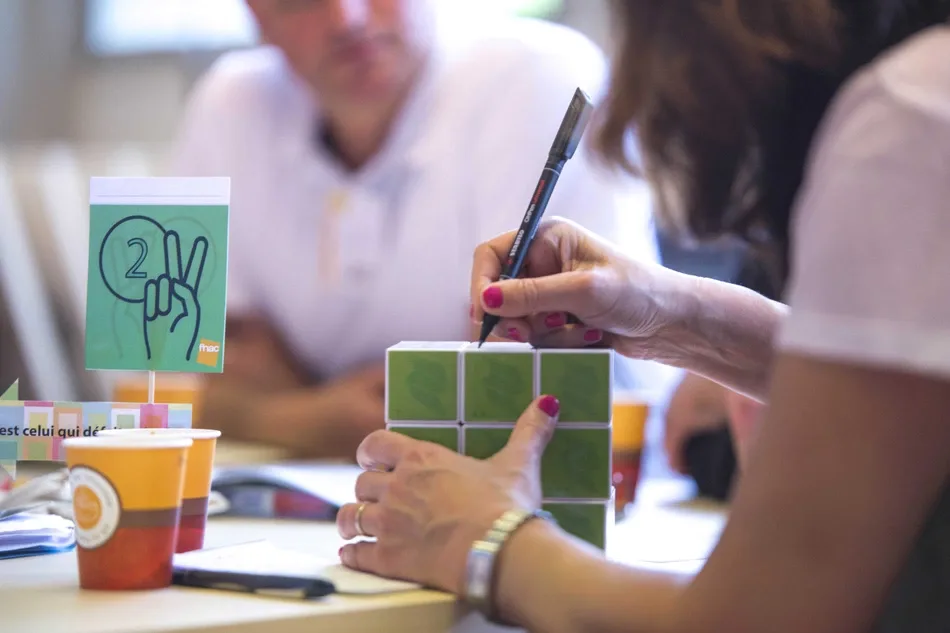
One giant Rubik's Cube as an innovation medium
Each team works on a giant Rubik's Cube whose six faces carry the dimensions of innovation: the customer, resources and the revenue model, and three other key innovation dimensions. Participants work in teams of six, with no fixed limit on the number of teams — facilitation and space are scaled accordingly.
Two phases, then a selection
Phase one models the cube: the company's current capabilities and practices, its competitors and untapped market opportunities. Phase two mixes the cube to surface combinations and develop ideas. Ideas are then positioned from feasibility to disruption, separating what can be tested quickly from more disruptive opportunities.
After the ideas: intrapreneurship and discipline
A selected idea is not yet a project. Opportunities can continue through intrapreneurship: explicit market and customer hypotheses, then structured progress with the Disciplined Entrepreneurship framework, developed at MIT by Bill Aulet.
A method created by Hélène Michel
Cubification was created by Opopoï cofounder Hélène Michel, who authored a book on the method with Pearson. We prepare the cube's faces, the materials and the facilitation from your business, so that every combination is meaningful for your group.
From the first exchange
to the next steps.
This sequence is illustrative. Content, working time and deliverables are designed around your context.
- 01
Model the cube
Map current capabilities, practices, competitors and untapped opportunities onto the six dimensions.
- 02
Mix and ideate
Combine the faces, build and describe new-offer ideas.
- 03
Rate the ideas
Position each idea from feasibility to disruption.
- 04
Choose what follows
Select opportunities, make their assumptions explicit and prepare the project's progress.
A format
built around you.
- Participants
- Innovation, product and marketing teams, entrepreneurs and internal venture teams.
- Group size
- Teams of six, with no fixed limit on the number of teams; facilitation and space are scaled to the group.
- Duration
- Designed around the question and the depth of exploration required.
- Languages
- French / English
Good
questions.
How many participants?
Teams count six people and there is no fixed limit on the number of teams: facilitation and space are scaled to your group.
Do participants need to know the method?
No. The session includes an introduction. Some context gathering beforehand helps us prepare what goes on the faces.
Does the cube make the decision?
No. It creates a structure for exploration. Participants and sponsors remain responsible for decisions and validation.
Can you facilitate in English?
Yes. Scoping, materials and facilitation are available in English or French, in Paris, throughout France and internationally.
You bring
the question.
We give it form.
A question to clarify. A team to bring together. An idea to put to the test. Let’s start with a conversation.
Discuss your next workshop